The current study aimed to assess the phytochemical profile of Macaranga indica (M. indica) leaves, as well as their antioxidant, thrombolytic, and neuropharmacological activities. Methanol extract from M. indica (MEMI) Wight leaves was used to investigate these activities to validate the therapeutic profile using a well-established method. GraphPad Prism, version 9.4.1 was used to analyze the experimental results. In vitro, the antioxidant DPPH free radical scavenging assay yielded an IC50 value of 9.58 µg/ml. Reducing power capacity showed an increase in absorbance with the increase of different concentrations. Quantitative analyses of phytochemical elicit the presence of phenol (777 ± 12.13), flavonoid (99.94 ± 0.62), flavonol (244 ± 2.53), total antioxidant (184.48 ± 1.92) mg/g in the dry extract. In vitro, thrombolytic activity showed a highly statistically significant (P < 0.0001) clot lysis (42.66 ± 3.19%). In vivo antidepressant, anxiolytic, and sedative activities evaluated the statistically significant (P < 0.001 at 200 mg/kg and P < 0.0001 at 400 mg/kg) by decreasing immobility time of forced swimming test (P < 0.0001) by reducing the anxiety of elevated plus maze and hole board test (P = 0.0106) and mice movement was gradually decreasing of hole cross test. These findings indicate that the crude extract of MEMI leaves has significant antioxidant, thrombolytic, and neuropharmacological properties.
INTRODUCTION
Since the beginning of civilization, people have used plants for various reasons [1, 2]. In 5000 BC, medicinal herbs have been utilized as part of the Ayurvedic medicine system [2]. Natural chemicals derived from medicinal plants and their plant extracts are used to treat a wide range of illnesses of human pathology [3]. Approximately 80% of the world's population uses herbal or plant-based treatments for several types of primary health care, according to the World Health Organization (WHO) [4]. Plant-based naturalistic products provide a wide range of nutritional benefits and are an excellent source of nutrients, such as antioxidants, phenolic compounds, and biological metabolites [5, 6]. Throughout illnesses and numerous degenerative diseases, free radicals could indeed severely damage tissues and cells [7]. Macaranga indica Wight (M. indica) (family: Euphorbiaceous; local name: Deshi bura) is a heterophyllous evergreen plant and its roots, bark, and leaves are used internally in ethnomedicine in the Southeast part of Asia, treat sores, cuts, wounds, stomach pains, diarrhea, hemoptysis, colds as well as fever [8]. The previous study of M. indica was primarily interested in determining the secondary metabolites (alkaloid, steroid, tannin, gum, and flavonoid), cytotoxic activity, and antioxidant activity of different M. indica ethanol bark extracts [9]. Through the literature survey, the present study was designed to scrutinize the antioxidant, thrombolytic, neuropharmacological potentials of the methanol extract of M. indica leaves in different experimental models.
MATERIALS AND METHODS
Collection and preparation of crude extract
Green leaves of M. indica were excerpted in April 2022 from the Sitakunda Eco Park (Botanical Garden), Chattogram, Bangladesh. Dr. Shaikh Bokhtear Uddin (A taxonomist, Associate Professor, Botany Department, Chittagong University) identified the plant. Collected leaves were shade-dried at room temperature (25 ± 2℃), and then finely powdered using a mechanical grinder and stored in an airtight sealed container [10]. About 150 g of the powdered substances from the sample were kept in a plain-bottomed glass jar with 450 ml (1:3 ratio) of methanol for soaking, accompanied by continuous quaking and stirring. Then, the entire mixture was sieved utilizing Whatman filter paper. The methanol extract obtained from the investigated plant was evaporated in a water bath at 45 °C.
|
|
(1) |
Chemicals & reagents
The analytical-grade chemicals and reagents were provided by the “Pharmacy Department of the International Islamic University in Chittagong”. Methanol (99.5%) was purchased from Sigma-Aldrich (Hamburg, Germany). Square Pharmaceuticals Limited in Bangladesh supplied the standard drugs streptokinase (1.5 million units/vial), fluoxetine, and diazepam.
Experimental animals
Male Swiss albino mice weighing 20-30 g and aged 1.5 months had been purchased from the Pharmacy Department at Jahangirnagar University in Savar, Dhaka, Bangladesh. For one week, mice were acclimatized to a new circumstance. The animals had been kept at 25 °C in a well-ventilated animal residence at some stage in the trial. They were given everyday grains in addition to easy-to-drink water. All the mice were maintained in a housing with a natural light or dark cycle (12 hours).
Phytochemical screening
MEMI was tested to carry out phytochemical constituents such as carbohydrates, saponin, proteins, tannins, alkaloids, flavonoids, quinones, and glycosides by following the process with small modifications [11, 12].
Quantitative phytochemical content analysis
Total phenolic content
Accepted methodologies were used to determine the amounts of phenolic components in MEMI [13].
Total flavonoid content
The entire flavonoid content of the MEMI was determined using the aluminum chloride (AlCl3) colorimetric method stated previously [13-15].
Total flavonol content
The previously mentioned procedure was employed to determine the entire flavonol content of MEMI [16].
Total antioxidant capacity
The TAC of MEMI extract was assessed by following the standard procedure [17].
Antioxidant activity
DPPH free radical scavenging activity
The DPPH radical scavenging activity of MEMI extract was assessed according to the protocol described earlier [18, 19]. MEMI was diluted in methanol at concentrations ranging from 100, 50, 25, 12.5, and 6.25 µg/ml, and then every test tube received 3 mL of a 0.004% w/v DPPH methanol solution. The percentage inhibitory activity was estimated using [(Ac-As)/Ac] × 100, where Ac is the control absorbance and As is the sample absorbance. The absorption spectra at 517 nm were calculated after 30 minutes against a blank. For reference, methanol was combined with ascorbic acid to create a stock solution with the same concentration. After making the inhibition plots, the IC50 (half-maximal inhibitory concentration) results were determined through regression analysis [20].
Reducing power capacity
The reducing power of the MEMI was determined by using an established technique [18]. The test samples were mixed with 0.625 ml of potassium buffer and 1% potassium ferricyanide solution at differing concentrations 200, 100, 50, 25, and 12.5 µg/ml. The mixture was incubated at 50 °C for 20 minutes to complete the reaction. Then, 0.625 ml of TCA solution (10%) was added to the test tubes. The entire mixture was subsequently centrifuged at 3000 rpm for 10 minutes. The supernatant (1.8 ml) was then taken out of the centrifuge tubes and mixed with 0.36 ml of FeCl3 solution (0.1%) before being added to 1.8 ml of distilled water. The absorbance of this solution at 700 nm was determined using a spectrophotometer. The increased absorbance showed a rise in reducing capacity [18, 21].
Thrombolytic activity
The thrombolytic activity was evaluated using the method described earlier by Sayeed et al. [22].
Ethical consideration
International Islamic University in Chittagong, female students of the Department of Pharmacy have taken blood samples. Each volunteer officially consented after being fully informed.
Study protocol
Streptokinase (1.5 million units/vial) and distilled water were used as the positive control and negative control respectively for the test. Vein blood was drawn from healthy female students (n = 8) and put in several pre-weighed, clean Eppendorf tubes (500 µl), which were then incubated at 37 °C for 45 minutes. The 100 µl of MEMI extracts were meticulously labeled and pre-weighed before being poured into each tube holding the clot. The control group received 100 µl of SK and 100 µl of distilled water separately. All of the tubes were incubated to check for clot lysis after 90 minutes at 37 °C. After that, the liquids produced were removed, and the tubes' weights were once again tested to see how much they had changed due to the lysis of the clot. The research on clot lysis utilized the following equation:
|
|
(2) |
In vivo neuropharmacology study plan
Each group (the standard, the control, and the two sample groups) of experimental mice consisted of three mice (n = 3). The control group received a solvent (10 mL/kg, p.o., 1% Tween-80 in distilled water), whereas the test groups received MEMI at doses of 200 and 400 mg/kg orally. According to mouse body weight, the conventional medications for FST were fluoxetine HCl (20 mg/kg, p.o.) and diazepam (1 mg/kg, i.p.) for EPM, HBT, and HCT.
Anxiolytic activity
Elevated plus maze test
Anxiolytic behavior in mice was evaluated by using the modified EPM method [23]. The EPM test was evaluated using the method previously reported. The dose was given, and the test mice were positioned in the EPM after 30 minutes. Both the closed and open arms were regarded for five minutes. During the evaluation, open arms entrance and total time spent were observed as well and the percentage of entries in open arms was also calculated.
Hole board test
The HBT test is a widely used method to evaluate anxiolytic activity and has been performed following the method published earlier [13, 23]. The experimental group was placed in the center of the board and permitted free circulation after 30 minutes the test dosage was administered. For a five-minute duration, the count of heads dipping into the vent for each mouse was noted.
Antidepressant activity
Forced swimming test
The FST test is the most popularly used biological animal model for the evaluation of antidepressant activity and has been performed following the method published earlier [11, 24]. Each mouse showed full motion at some stage in the starting 2 minutes. Then, in the next four minutes of the total six minutes of the check-out time, the duration of inactivity was properly noted. Mice had been labeled motionless when they remained consistent while floating, aside from the movements required to maintain their heads above water.
Sedative activity
Hole cross test
Sedative behavior in mice was evaluated by using the modified Hole Cross method of Kabir et al. [18]. The animal was placed in the center of the hole, to observe the number of holes that moved from one chamber to the next. Then for 3 minutes [24], recordings were made at 0, 30, 60, 90, and 120-minute durations [18].
Statistical analysis
To examine the data and a significant relationship between the sample and control groups, one-way ANOVA Dunnett's test was utilized, with multiple comparisons being performed using GraphPad Prism, version 9.4.1 (GraphPad Software Inc., San Diego, CA). To evaluate if an association was statistically significant, P-values lower than 0.05 were utilized. The data were shown as the average and SEM.
RESULTS AND DISCUSSION
Qualitative phytochemical screening
The findings of the qualitative analyses of secondary metabolites from MEMI are shown in Table 1.
Table 1. Qualitative phytochemical screening of MEMI
|
Secondary metabolites |
Test name |
Interference |
|
Carbohydrates |
Molisch’s test |
+ |
|
Benedict’s test |
+ |
|
|
Saponins |
Foam test |
+ |
|
Proteins |
Millon’s test |
+ |
|
Alkaloids |
Mayer test |
+ |
|
Wagner’s test |
+ |
|
|
Dragendroff’s test |
+ |
|
|
Hager’s test |
+ |
|
|
Phenols |
Iodine test |
+ |
|
Lead acetate test |
+ |
|
|
Flavonoids |
Lead acetate test |
+ |
|
Terpenoids |
Chloroform |
- |
|
C-glycosides |
Glacial acetic acid test |
+ |
Note: (+) means present, (-) means absent
Quantitative phytochemical content analysis
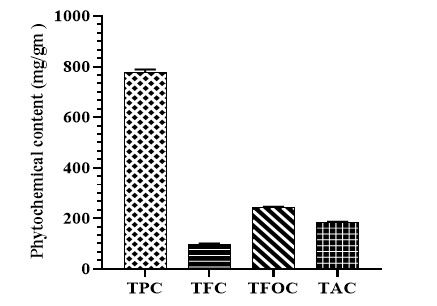
The values represented the total phenols, flavonoids, flavonols, and antioxidant capacity of MEMI extracts in Figure 1. The extract contains a high number of total phenols, as well as a considerable number of total flavonoids, total flavonols, and total antioxidants based on the data.
 |
|
Figure 1. Quantitative phytochemical contents. |
DPPH free radical scavenging activity
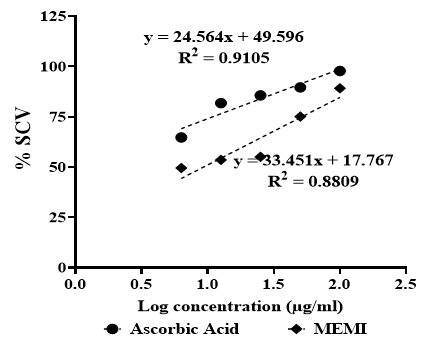
The IC50 of MEMI was 9.58 µg/ml which is more closely correlated, whereas ascorbic acid (IC50 value: 1.03 µg/ml) was used as a standard for comparison (Table 2 and Figure 2).
Table 2. DPPH free radical scavenging of MEMI.
|
Conc. (µg/ml) |
% SCV of MEMI |
IC50 (μg/ml) |
|
6.25 |
49.58 |
9.58 |
|
12.5 |
53.56 |
|
|
25 |
55.09 |
|
|
50 |
75.12 |
|
|
100 |
89.18 |
Reducing power capacity
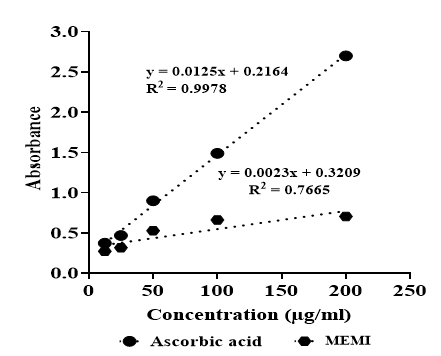
According to the results, the power of reduction increased proportionally as the extract concentration increased (Figure 2).
|
|
|
|
a) |
b) |
|
Figure 2. Antioxidant activity Note: Calibration curve of ascorbic acid and MEMI for the a) DPPH free radical scavenging, and b) Reducing power assay. |
|
Thrombolytic activity
In comparison to the standard medicine Streptokinase (72.865 ± 1.579%), distilled water achieved little lysis of clot (10.472 ± 0.935%), and the MEMI achieved (42.663 ± 3.191%, ****P < 0.0001) clot lysis (Table 3).
Table 3. Thrombolytic activity of MEMI by determining the percentage of clot lysis.
|
Groups |
% Clot Lysis |
|
|
Dist. water |
Negative control |
10.983 ± 0.935% |
|
Streptokinase |
Positive control |
72.865 ± 1.579%**** |
|
MEMI |
Extract |
42.663 ± 3.191%**** |
Impacts of MEMI in the elevated plus maze test
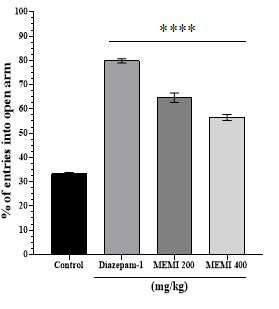
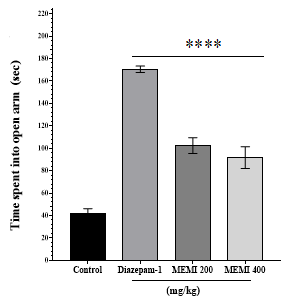
The results of the test showed that MEMI at dosages of 200 and 400 mg/kg p.o. increased the frequency of entry into open arms as well as the amount of time spent there in a dose-dependent approach (Figures 3a and 3b). By comparison with the control group, MEMI dosages, and the standard drug had the most significant action (****P < 0.0001).
Impacts of MEMI in the hole board test
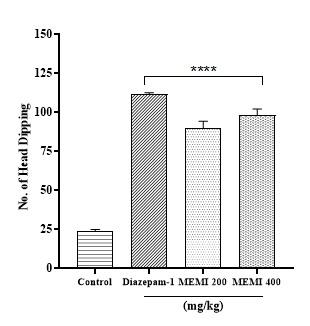
MEMI administered at doses of 200 and 400 mg/kg p.o. in HBT showed significant value when compared to the control group in experimental animals. The higher dosage substantially enhanced the frequency of dipping heads (Figure 3c). The results have been presented with the P-value < 0.0001 being statistically extremely significant.
Impacts of MEMI in the forced swimming test
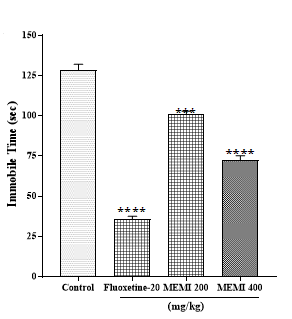
The results (Figure 3d) demonstrated the effects of oral MEMI ingestion on the time of immobility in the test. The duration is diminished in a dose-dependent approach at dosages of 200 and 400 mg/kg p.o. for the experiment.
|
|
|
|
a) |
b) |
|
|
|
|
c) |
d) |
|
Figure 3. Anxiolytic activity and antidepressant activity Note: The impacts of MEMI on EPM test; a) Effects of MEMI extract on % of entries into open arm in EPM test, b) Effects of MEMI extract on time spent in open arms (sec), c) The impacts of MEMI on HBT, and d) The impacts of MEMI on FST. |
|
Impacts of MEMI in the hole cross-test
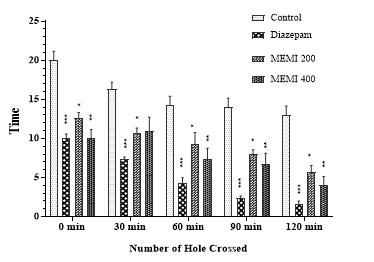
Locomotion action at two MEMI doses 200 and 400 mg/kg, p.o. is presented in Figure 4. MEMI treatment considerably reduced the number of holes crossed at practically all doses. The P-value of diazepam (***P < 0.001), the adjusted P-value of MEMI 200 mg/kg (*P = 0.0106), and MEMI 400 mg/kg (**P = 0.0021) were all statistically significant compared with the control.
 |
|
Figure 4. Sedative activity |
There is a significant amount of evidence that supports the usage of herbs in traditional medicinal systems for curing illnesses, healing, and enhancing physiological systems [25]. The evaluation of qualitative phytochemical profiling of MEMI demonstrated the arrival of main phyto components, for example, carbohydrates, alkaloids, glycosides, flavonoids, proteins, tannins, saponins, and phenols. It has been found that flavonoids act as scavengers of free radicals in a range of oxidation products [14]. The destructive function of free radicals in several illnesses, such as malignancy, dementia, and heart disease, can be prevented through antioxidative activities. MEMI was the most beneficial in this analysis; the extracts showed overall high antioxidant potential. MEMI was investigated for thrombolytic activity as part of the development of cardiovascular preventive medicines from plant sources and revealed a highly significant lysis of clots. MEMI in vivo has neuropharmacological activity. The most common affective mental illnesses recognized in the healthcare profession are anxiety and depression. Both of these conditions bring about a decline in physical condition [23]. In the investigation at both doses of MEMI, mice reduced anxiety-like behavior and showed extremely significant anxiolytic action. Sedative interest can rescue sleep disorders. The hole cross (HC) test has been observed to gradually reduce mouse movement, which is comparable with the sedative effects of the control. The locomotion activity obtained by the MEMI showed good significance in comparison to the control.
CONCLUSION
Consequently, the studies were designed to investigate the impact of clinical use. In this observation, in vitro phytochemical screening, antioxidant, thrombolytic, and in vivo neurological experiments have been assessed. The methanol leaf extract of M. indica exhibited realistic to wonderful activity especially. Hence, the plant M. indica might be taken into consideration as a beneficial direction for researchers to investigate further to discover and extract valuable substances with medicinal properties.
ACKNOWLEDGMENTS: This research is acknowledged by the Department of Pharmacy, International Islamic University Chittagong, Bangladesh, for research facilities and other logistic support.
CONFLICT OF INTEREST: None
FINANCIAL SUPPORT: None
ETHICS STATEMENT: The Project was approved by the departmental planning and development committee Reference number: Pharm/P&D/200/16-'22 dated 2nd March 2022 (Wednesday) by the Department of Pharmacy, International Islamic University Chittagong, Bangladesh.

 IJPRAS