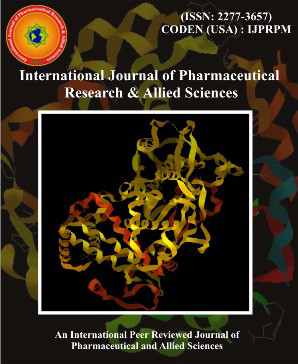

The International Journal of Pharmaceutical Research and Allied Sciences (IJPRAS) [ISSN: 2277-3657] is an international, open-access journal published quarterly. All submitted manuscripts undergo a double-blind peer-review process to support impartial and rigorous editorial assessment.
IJPRAS provides a scholarly platform for researchers, academics, healthcare professionals, and industry specialists to communicate research findings and informed perspectives. The journal publishes original research papers presenting methodologically sound and previously unpublished work, as well as critical review articles that examine and synthesize developments within clearly defined subjects.
Through open access publication, the journal seeks to make scientific knowledge available to readers worldwide and facilitate constructive academic exchange. IJPRAS is committed to the publication of clear, reliable, and relevant scholarship that can support further research, professional practice, and informed decision-making.
Aims and Scope
The International Journal of Pharmaceutical Research and Allied Sciences (IJPRAS) [ISSN: 2277-3657] is a comprehensive, open-access scholarly journal that follows a double-blind peer-review process.
The journal aims to advance theoretical, experimental, computational, and clinical knowledge in pharmaceutical research and allied sciences by publishing high-quality original research articles, reviews, and other scholarly contributions. It seeks to connect fundamental discoveries with pharmaceutical development, clinical application, and patient-centered care while promoting interdisciplinary and translational research across the pharmaceutical sciences.
The journal welcomes original research and review articles in the following areas:
1. Pharmaceutical Sciences and Drug Development
o Pharmaceutics, formulation science, and advanced pharmaceutical formulations, including solid, topical, parenteral, and novel drug delivery systems
o Nano- and targeted drug delivery systems, biomaterials, and pharmaceutical nanotechnology
o Medicinal chemistry, pharmacognosy, natural products, and drug discovery
o Pharmacology, toxicology, pharmacovigilance, and drug safety
o Pharmaceutical analysis, analytical chemistry, pharmaceutical technology, manufacturing, quality assurance, and regulatory affairs
o Biopharmaceutics, clinical pharmacokinetics, pharmacodynamics, and PK/PD modelling
o Biopharmaceuticals, biosimilars, and pharmaceutical biotechnology
2. Computational and Precision Pharmaceutical Sciences
o Pharmacoinformatics, cheminformatics, bioinformatics, computational biology, and computer-aided drug design
o Quantitative structure–activity relationship (QSAR) modelling and molecular modelling
o Molecular dynamics simulations, molecular docking, virtual screening, and related computational methods
o Pharmacogenomics, precision pharmacotherapy, personalized medicine, and biomarker-guided treatment
o Artificial intelligence, machine learning, and data-driven approaches relevant to drug discovery, development, and therapeutic decision-making
3. Allied Biomedical and Health Sciences
o Biotechnology, microbiology, biochemistry, molecular biology, pathology, and neurosciences
o Biomaterial sciences, tissue engineering, and biomedical applications relevant to pharmaceuticals
o Clinical pharmacy, pharmacotherapy, pharmacoepidemiology, and pharmaceutical care
o Health outcomes research, pharmacoeconomics, real-world evidence, and evidence-based medicine
4. Translational and Interdisciplinary Research
o Translational pharmaceutical research connecting laboratory discoveries with preclinical studies, clinical development, and therapeutic applications
o Interdisciplinary approaches to drug discovery, formulation development, delivery, evaluation, and clinical use
o Emerging technologies and innovative methods in pharmaceutical and biomedical research
o Sustainable pharmaceutical manufacturing, green chemistry, and environmental biotechnology
o Bioremediation, pharmaceutical waste management, and environmental studies with direct relevance to pharmaceuticals
Announcement and Advertisement
Announcements regarding scientific activities such as conferences, symposium, are published for free. Advertisements can be either published or placed on website as banners.
Publishing Schedule: 4 issues per year (January, April, July, October).
 IJPRAS